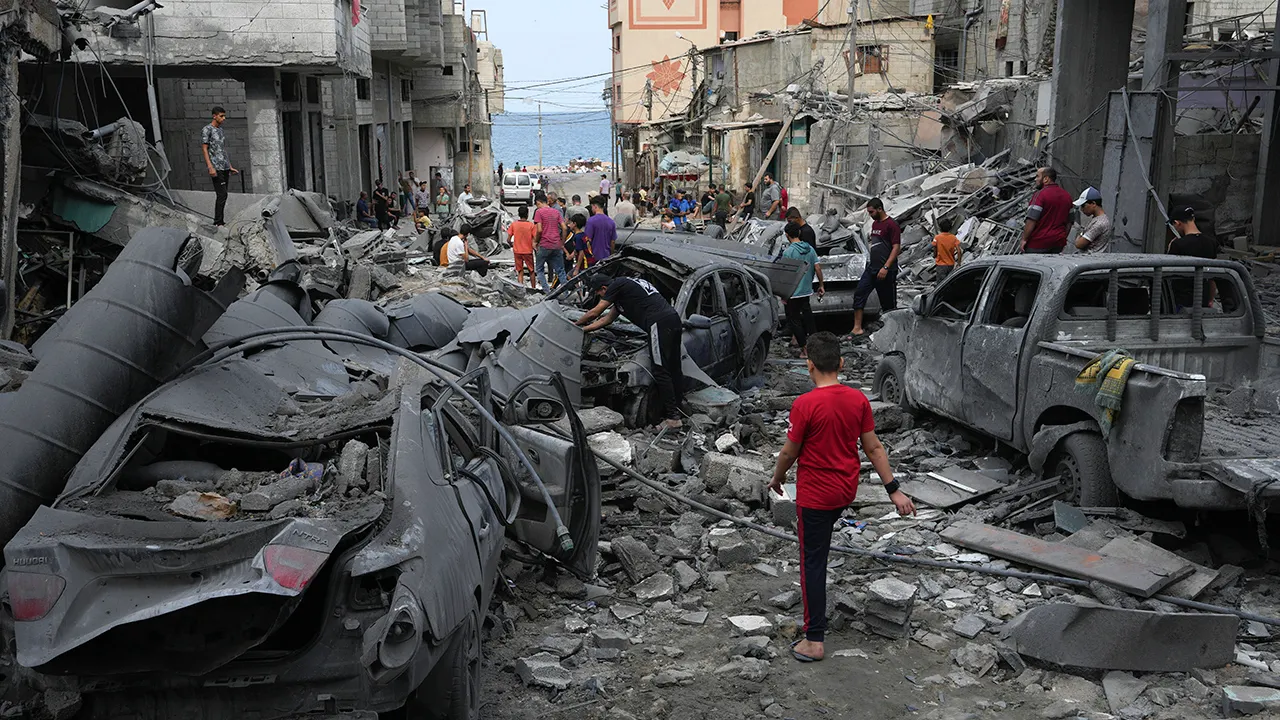
It is Not Antisemitic to Oppose Israel’s Warfare against the Palestinians in Gaza

Make no mistake about it: I believe in the sanctity and inherent equality of human life. Accordingly, I am a pacifist. I oppose war, capital punishment, and policies of all government entities that cause unnecessary human deaths. Accordingly, I oppose what appears to me to be the genocidal warfare of the State of Israel against the Palestinians in Gaza and the West Bank.

As a pacifist, I condemned the 7 October 2023 attack of Hamas on Israel that resulted in the deaths of more than 1,200 people in Israel. I also vehemently condemn the retaliatory warfare of Israel that to date has killed more than 53,000 Palestinians, a large percentage of whom are women and children. Thus, I agree with Britain, France, and Canada who have recently called the Israeli plans for the escalation of the war against Hamas “disproportionate” and “egregious” at a time when the U.N. is warning that Palestinians in Gaza are at great risk of famine. (See this NY Times article.)

As a pacifist, I also vehemently condemn the murder of two Israeli Embassy staff members in Washington, D.C., on May 21. Sarah Milgrim, the young woman killed, was from Johnson County, Kansas, in the Kansas City metropolitan area. The Kansas City Star appropriately noted the outpouring of sympathy for her family and friends for their great loss.

Concurrently, I also censure Israel’s ongoing warfare in Gaza. PBS News reported that on May 20, Israel launched airstrikes that killed at least 85 Palestinians, many of whom most likely were women and children.

As an egalitarian, I firmly believe that the lives of each Palestinian killed this week were as sacred as the lives of the two Embassy staff members. The outrage against the murder of the young couple in D.C. is completely warranted. But indignation against the killing of Palestinians in Gaza and the West Bank is often muted by charges of antisemitism.

On May 16, New York University said it is withholding the diploma of a student who used his commencement speech to condemn Israel’s war in Gaza and what he referred to as the U.S.’ “complicity in this genocide.” The same thing has happened more recently at George Washington University. (See the Washington Post articles here and here.)

Is the murder of two prominent people in D.C. more reprehensible than the wanton killing of tens of thousands in Gaza? I think not since I abhor the willful taking of human life anywhere for any reason.

The cold-blooded killing of the Israeli staff has widely been called another example of antisemitism in the U.S. For example, the day following the D.C. shootings, Senator Chuck Schumer (D-NY), said, “Last night, just a few blocks from here at the Capital Jewish Museum, the scourge of antisemitism reared its ugly head yet again in America. The sickening, cold-blooded murder of two Jewish staffers from the Israeli embassy seems to be another horrific incident of antisemitism, which we all know is too rampant in our society.”

But was the shooting really because of antisemitism? I doubt it. The shooter reportedly shouted, “Free, free Palestine!” while in custody. He didn’t shout, “Kill, kill Jews!” He is also reported to have declared, “I did it for Palestine, I did it for Gaza.” At this point, there is no indication whatever that he harbored hostility toward Jews in the U.S.

I certainly don’t doubt that there has long been antisemitism (=prejudice against or hatred of Jews) in the U.S. and in the broader world, and I deplore all prejudice against and mistreatment of Jews, past or present—as well as all prejudice against and mistreatment of any other religious, ethnic, or cultural demographic.

However, I also think the treatment of Palestinian people since the Nakba began on May 15, 1948, is equally deplorable. (For detailed information about the Nakba, click here.)

So, whether you agree with me or not, I hope you will carefully consider my main assertion: it is not antisemitic to oppose Israel’s warfare against the Palestinians in Gaza and the West Bank. And please join me in prayer that the hostilities there will soon come to an end.

Posted in Blog article | Tagged , , , | 14 Comments

Remembering Tony Campolo with Deep Appreciation

On my top ten list of “Stimulating, Challenging Speakers/Writers” I have heard/read, Tony Campolo is the seventh as listed chronically by year of birth. Through the years, I had the privilege of hearing him speak on two or three occasions and chatting with him briefly. With deep appreciation, I am posting this article today on the 90th anniversary of his birth.

Anthony Campolo Jr. was born 90 years ago today on February 25, 1935 (three and a half years, minus ten days, before I was born). His parents were Italian Americans in Philadelphia. Tony went to Eastern College, Eastern Baptist (now Palmer) Theological Seminary, and Temple University in that city, obtaining a Ph.D. degree at the latter in 1968.**

Wikipedia correctly notes that Campolo was a sociologist, Baptist pastor, author, and public speaker. I have long felt an affinity with him for those, as well as other, reasons. I was a sociology major in college, and he and I were ordained as Baptist pastors in the same year (1957). I am also an author and have been a public speaker, but to a considerably less degree than Campolo. And the positive influence I have had on others is minuscule compared to his.

It was with sadness that I heard on November 19 of last year that Campolo had died.

In his more than three dozen books, Campolo focused on Christ’s teachings about uplifting those in poverty, anti-war views, protection of those suffering, and lessons on wealth inequality. In 2007, he and Shane Claiborne (one of his former students) co-founded Red Letter Christians, a movement focusing on Jesus’ stated views regarding social justice.

In a Nov. 20, 2024, article, Jim Wallis states that Campolo was “a great preacher but was, above all, an evangelist who proclaimed ‘good news to the poor,’ just as Jesus did when he launched his mission at Nazareth.” Later in that piece, Wallis refers to Campolo as “an evangelist to evangelicals.”

In addition to Claiborne, another of Campolo’s many students who are carrying on his work is Bryan Stevenson (b. 1959), of whom I posted a blog article (see here).

Here are some of my favorite quotes of Campolo:

Jesus refers to the poor over and over again. There are 2,000 verses of Scripture that call upon us to respond to the needs of the poor. And yet, I find that when Christians talked about values in this last election that was not on the agenda, that was not a concern. If you were to get the voter guide of the Christian Coalition, that does not rate. They talk more about tax cuts for people who are wealthy than they do about helping poor people who are in desperate straits.

“Putting religion and politics together is like mixing ice cream with horse manure. It doesn’t hurt the horse manure; it ruins the ice cream. And I think that this merger of church and state has done great harm to religion.” (2006)

“The gospel is not about… pie-in-the-sky when they die. … It is imperative that the up and coming generation recognize that the biblical Jesus was committed to the realization of a new social order in this world. … Becoming a Christian, therefore, is a call to social action.”

Campolo, known also for his sense of humor, also is said to have spoken these tongue-in-cheek words: “I’ve always been skeptical of those television healers who are bald. If I had that gift, that’d be the first thing I’d fix.”

_____

** My younger daughter also acquired a Ph.D. at Temple U. (in 2000).

Posted in Blog article | 8 Comments

“I Heard the Bells”: Reflections on a Splendid Christmas Carol

On Thanksgiving night, my wife and I watched the movie I Heard the Bells (2022), based on the true story of Henry Wadsworth Longfellow. It focused on “Christmas Bells,” the Christmas carol he composed on Christmas Day 1863, the month after his son Charley had been severely injured in the Civil War.*1

On Christmas Day 2018, I posted “Can You Hear the Christmas Bells?” on my main blogsite (see here) and then referred to that same carol again at the end of my 12/23/20 blog post. Longfellow’s poem, which became a widely sung Christmas carol, begins with the words, “I heard the bells on Christmas Day.”

For reasons I don’t understand, though, Longfellow’s powerful words don’t seem to be known or sung in some Christian circles. That carol is not in The New Century Hymnal (1995) or the new (2020) Voices Together hymnal of the Mennonite Church USA.

Since Longfellow wrote the poem during the Civil War, two of the seven verses explicitly relate to that tragic conflict. But the Baptist Hymnal (among many other hymn books) omits those two and includes only five of the original verses.

When Longfellow’s son Charley left to enroll as a Union soldier (in March 1863), it was against his father’s strong disapproval. That was about three months before Charley’s 19th birthday. Still grieving his mother’s accidental death in 1861, he was seriously questioning his Christian faith.

In the movie, Charley says to his famous father, “I will not believe in a God who is sleeping, or maybe dead.”

At that time, Henry Longfellow was grieving even more than Charley, and that grief was intensified when Charley was shot through the shoulder, with the bullet traveling through his back and clipping his spine.*2

During this time of intense agony, Longfellow started writing the poem “Christmas Bells.” “In despair,” he wrote, “I bowed my head. There is no peace on earth, I said.” And then, thinking about the words of doubt Charley had uttered, he began to wonder if, indeed, God was sleeping or even dead.

But then Longfellow’s faith overcame his doubts. In the powerful last stanza, he concluded his splendid Christmas carol on a note of triumph:

Then pealed the bells more loud and deep… / God is not dead, nor doth he sleep. / The wrong shall fail, the right prevail, with peace on earth, goodwill to men.

Few of us currently have as much grief as Longfellow was experiencing on that Christmas Day in 1863. But even if things are going well for us personally, many of us grieve over the situation in parts of the world such as Gaza and the West Bank, Ukraine, Sudan/South Sudan, Afghanistan, Haiti, and everywhere there is warfare, rampant hunger, and persistent poverty.*3

Here in the U.S., many people of goodwill are deeply concerned about the welfare of the immigrants currently in the country, the likelihood of an increasing number of citizens siding into poverty with diminished help from the government as well as loss of medical insurance, and other social problems.

In such a time as this, we need the faith and hope that Longfellow expressed: “the wrong shall fail, the right prevail.” That did happen in Longfellow’s day to an important extent. The Civil War did end, enslaved people gained freedom, and there was greater liberty and justice for all.

May the celebration of Christmas this year, with or without bells, lead us all to deeper faith and hope—and action for the welfare of all—in the year ahead.

_____

*1 The film is available for streaming (for a few dollars) on Amazon Prime. It is also available without further charge for those who subscribe to Pure Flix, a streaming service that I learned about just last month. It is a conservative Christian site that claims to be “the streaming leader in faith & family entertainment” (see here).

*2 The battle in which Charlie was injured was near the New Hope Church in Virginia. In that battle, Union troops fought soldiers led by General Robert E. Lee. I mentioned that battle and Charlie’s serious injury in a May 2012 blog post.

*3 Here is a link to the website of the World Food Programme with information about the “10 Countries Suffering the Most From Hunger.”

Note: Some online sources give the date for Charley’s wartime injury and his father’s writing of “Christmas Bells” being in 1864 rather than 1863. However, I am going by what seems to be the general consensus, according to AI, and one of the best sources/articles (with several images ) about this subject is the one found here. I recommend it to those who want to read more about the historical events.

Posted in Blog article | Tagged , | 11 Comments

Christian Values and the Election

Well, here we are: the weekend before the 2024 election in the U.S., and perhaps it is no exaggeration to say that it is the most important election in the nation’s history since 1932—or maybe even since 1860. In this post, I am considering how “Christian values” will potentially impact the outcome.

What are Christian values? That is a pivotal question that must be considered first. The problem is that the answer depends on what kind of Christian seeks to answer that question.

Back in January 2019, I posted “Two Christianities?” In that blog article, I sadly concluded that the current differences between conservative evangelical Christianity and progressive/liberal Christianity are so great it is perhaps correct to say they are, indeed, largely two different Christianities.

With regards to the presidential election, those who endorse the first form of Christianity seem to think that the most important Christian values impel being anti-abortion (expressed as being pro-life) and anti-LGBTQ (with anti-trans sentiment currently being the strongest).

Because of email exchanges with Tom Lamkin, a Southern Baptist pastor friend in North Carolina (whom I baptized in 1959 when he was a boy in Kentucky), I started reading Gary Bauer, a far right-wing Christian (Southern Baptist) pundit.*

Bauer recently wrote that he is opposed to Harris because of her strong commitment to killing babies and mutilating children. And he repeatedly writes about the extensive “lies of the left” (see this 10/23 post).

In an email last week, Tom wrote, “I was with two pastors this morning and they will be voting for Trump. They seem to hear nothing Trump is saying except the condemnation of abortion and the gender chaos.” Perhaps they were not just reading but also agreeing with Bauer’s outrageous statements.

The other Christianity, which I affirm, sees the following among the primary Christian values to uphold regarding the election and at all times.

** Loving God and other people (the two greatest commandments according to Jesus, see Mark 12:28~31).

** Seeking the Kingdom of God and God’s righteousness (=justice, see Matthew 6:33).

** Observing the Golden Rule (see Matthew 7:12)

** Having compassion for “the least of these” (see Matthew 25:40~45).

** Practicing creation care (see Psalm 24:1).

Much more could (and maybe should) be written about these values, but I think you get the point.

Are Christian values tied to White Christian Nationalism? I was a bit nonplussed by PRRI’s American Value Survey conducted mostly in August.** Registered voters were asked which presidential candidate they would vote for if the election were held right then.

Of those surveyed, 45% said they would vote for Harris and 40% for Trump. But 72% of those who identified as White evangelical Protestants, chose Trump. That was not unexpected, but I was quite surprised at the next two listings.

Only 34% of White Catholics chose Harris, and 55% said they would vote for Trump. Even more surprising/perplexing was that of White mainline/non-evangelical Protestants, only 36% were for Harris and 53% were for Trump.

By contrast, Hispanic Catholics chose Harris over Trump by 52% to 27%, and Black Protestants said they would vote for Harris overwhelmingly, 78% to 9%. (The percentages don’t add up to 100 as some were “not sure” and others were for a third-party candidate.)

This survey made me wonder if some/many White Catholics and non-evangelical Protestants don’t support Harris because she is a person of color and/or a woman. Many in the Christian Nationalism movement likely think the country ought to be governed by White Christian men.

If VP Harris loses the election, which I think is certainly possible although I remain confident that she will win the popular vote, it will be because of the votes of White Christians more than any other chosen demographic (that is, other than non-chosen demographics such as gender, race, or “class.”)

So, on this weekend before the election, I plead with those of you who are Christians (and haven’t voted yet) to consider well what the core Christian values really are and to vote accordingly.

_____

  * Bauer (b. 1946) is also the president of American Values, a non-profit organization “committed to defending life, traditional marriage, and equipping our children with” conservative values. Some of you may remember that he ran for the Republican nomination for U.S. president in 2000.

** PRRI (Public Religion Research Institute) is a nonprofit, nonpartisan organization that conducts public opinion polls on a variety of topics, specializing in the quantitative and qualitative study of political issues as they relate to religious values. Robert P. Jones established PRRI in 2009. He holds a Ph.D. in Religion from Emory U. and an M.Div. from Southwestern Baptist Theological Seminary. Jones is the author of The End of White Christian America (2016) and White Too Long: The Legacy of White Supremacy in American Christianity (2020).

Posted in Blog article | Tagged , , | 16 Comments

Listen to the Women!

At this critical juncture in USAmerican history, I have been thinking this morning about how helpful it is to listen to outstanding women who have spoken and are speaking words that need to be heard and taken with utmost seriousness.

At the top of the list, of course, is Vice President Kamala Harris. I trust that you who read this will not only listen to what Kamala says but that most of you will vote (or maybe have already voted) for her to become the next POTUS.

Reading Heather Cox Richardson’s latest newsletter, which I read this morning (and which you can find here), sparked my thinking and led to writing this brief essay. Six nights a week, Dr. Richardson (b. 1962) publishes what she calls “letters from an American,” and I read them early every morning. She is a history scholar (and a faculty member at Boston College), and her daily posts are usually regarding significant current matters, often seen concerning past historical events.

As is true of today’s letter, in recent days/weeks Heather has written often about the danger she sees in what Donald Trump says at his campaign rallies and elsewhere. Today’s post was one of her strongest Ietters yet. She unquestionably sees Trump as a threat to democracy in the U.S. But her newsletters are not written by one who is a partisan Democrat. She is registered as an Independent, and she self-identifies as a Lincolnian Republican.

I encourage all of you who read this to click on the link above and read what Dr. Richardson wrote last night. Much of what she said was about Dorothy Thompson, an American journalist and newscaster. I can’t remember hearing of Ms. Thompson (1893~1961) previously, but she was a highly influential woman in the 1930s and ’40 as she chronicled pertinent news about Hitler and the Nazis. And Dr. Richardson sees frightening parallels between what Thompson wrote about Hitler and what she hears Trump saying today.

In addition to Ms. Thompson, Heather also introduced the following woman whom I hadn’t heard of before, but now I am signed up to receive her Substack posts regularly.

Rachel Bitecofer is an American scholar with a Ph.D. in political science. Dr. Bitecofer (b. 1977) yesterday posted “What (Really) Happens If Trump Wins? Like Hitler, Trump Has Made Clear His Plan is Dictatorship, Not Democracy” on Substack. (Here is a link to that lengthy and informative article.)

Reading that essay made me think that Rachel is another woman that I/we need to listen to.

Jessica Piper is also a woman I heard about from Heather Cox Richardson, and I have been a regular reader of her Substack posts since first learning about her–and I was surprised to find out soon that she lives on a small farm only about 25 miles from my hometown in northwest Missouri.

Jess (as she is commonly called) was a high school English teacher for over a decade and then ran for the office of Missouri Representative, losing badly in rural Missouri where more than 80% of the voters cast their ballots for Trump in 2016 and 2024. According to a local Kansas City 2022 publication, she has more than 200,000 followers on her social media, and “she represents progressive rural Missourians who aren’t on board with the state’s highly conservative policies.”

In addition to her numerous Substack posts (accessible here), she speaks to small groups of Democrats and Independents across the Midwest. There is some unevenness in her posted articles, but she is another woman worth listening to–especially if you live in Missouri or the neighboring states on the north and west.

These are just three (or four if you include VP Harris) women that are worth listening to, especially now as it is only two weeks until Election Day.

Posted in Blog article | Tagged , , , | 5 Comments

Reflections on Harris’s Acceptance Speech

Last night at the concluding session of the Democratic National Convention, Vice President Kamala Harris gave her acceptance speech for the nomination as the Democratic candidate for November’s presidential election.

I didn’t listen to the speech live since it began after my bedtime, but by 5:30 this morning (Aug. 23), I had read the full transcript and then later in the morning I watched her deliver her speech on YouTube. Listening to her powerful speech, as well as vice presidential nominee Tim Walz’s speech given the previous day, solidified my support for Harris and Walz. (My blog post on August 9 was titled “In Support of Harris and Walz.”)

What I liked in Harris’s speech

Please recognize that what I am writing here are my views as a Christian and only secondarily as a Democrat. Thus, it was noteworthy that early in her speech Kamala made reference to the Golden Rule as taught by Jesus. She didn’t refer to those words by that name, but she spoke of “the importance of treating others as you would want to be treated. With kindness, respect and compassion.”

A little later, she remarked, “In our system of justice, a harm against any one of us is harm against all of us.” That is somewhat related to the Golden Rule–but also to the South African concept of ubuntu, that wonderful word/concept I wrote about in an April 2021 blog post (see here).

Regarding what she called “the war in Gaza,” Kamala declared that “now is the time to get a hostage deal and a cease-fire deal done.” After clearly stating that she would “always stand up for Israel’s right to defend itself,” she went on to state that “what has happened in Gaza over the past 10 months is devastating. … The scale of suffering is heartbreaking.”

And then notably, she spoke of how she and Pres. Biden are working to end this war so that “the Palestinian people can realize their right to dignity, security, freedom, and self-determination.” As one who is greatly concerned about peace and justice for all people, and especially for those who have been most unjustly treated, that is the position I want the U.S. president to take.

What I didn’t like in Harris’s speech

One thing I didn’t like about Kamala’s speech was her repeated reference to fight/fighting. Those words had been used repeatedly during the convention, and she used them at least 15 times in her acceptance speech. Yes, I know, as Merriam-Webster’s online dictionary says, the second meaning of fight is “to put forth a determined effort,” but the first meaning is “to contend in battle or physical combat.” As a Christian pacifist, I wish she would have used terminology that didn’t include the possibility of physical violence.

Secondly, while there was reference to helping the middle class–and certainly there is much that needs to be done in that regard–there was hardly anything said about helping those who are living in poverty, which, unfortunately, is a sizeable percentage of the USAmerican population. (A week from today, I am planning to post an article titled “Considering ‘the Least of These'” on my regular blogsite.”)

And then–and this is the biggest problem I saw in Harris’s speech–there was no recognition of the coming ecological crisis that I have written about repeatedly in the last two and half years. She said one sentence noting the need for “freedom to breathe clean air, and drink clean water and live free from the pollution that fuels the climate crisis.” But the looming ecological crisis is so much more than that.

The speech ended with a clarion call for all of us “on behalf of our children and our grandchildren,” and “guided by optimism and faith,” to help write “the next great chapter in the most extraordinary story ever told.” Unless there are drastic changes implemented soon, that next great chapter will, sadly, most likely be short indeed.

Posted in Uncategorized | Tagged , | 16 Comments

When and How Will People Know the Truth and Be Set Free?

In my regular blog post on May 30 (see here), I cited the highly significant words of John 8:32 in the New Testament: “You will know the truth, and the truth will set you free.” Those words have relevance far beyond the context in which they were originally spoken/written, relevance that extends to the chaotic political situation in the U.S. at this time.

Since the announcement of the jury’s verdict that Donald J. Trump was guilty of the 34 felonies he had been charged with in New York City, there has been a multitude of lies and misleading statements spoken and written by Trump himself and by Trump supporters, including some of the right-wing news media. And that is a major problem.

There is a huge number of people in this country whose information about the result of the historic trial in which a former U.S. President was convicted of a felony comes from Trump himself, from biased media such as Fox News or Breitbart.com (among many others), and/or from “talk radio.” If that is how people get the information that they think is true, how are they ever going to know the truth?

Here is the link to a post made on May 31 by APNews.com, stating that in the talk Trump made in front of Trump Tower that day, “he repeated numerous false or unsupported claims” ranging “from blaming the Biden administration for orchestrating the hush money case to other false claims about the trial and other issues facing the country.” (Associated Press, AP, is one of the most unbiased news sources.)

Even major newspapers can be highly biased. A case in point is the New York Post, whose daily printed copies are about the same as the Washington Post (about 136,000 in 2023, although about half of the print circulation of the New York Times). The front page of New York Post’s “late city final” for May 30 had the bold headline “INJUSTICE” at the top and then, “NYC jury makes Donald Trump first felon president after political hit job.”

“Injustice” and “political hit job” are words of opinion; they are not objective facts. Similarly, much of what appears on Fox News is pro-Trump, pro-MAGA, right-wing propaganda. Consider “Fox News on the evening of the Trump felony conviction,” an article posted today (here) by historian John Fea.

The voting public badly needs to have true, factual information about what is happening in general and about the result of the Trump trial in particular. They need to be set free from the lies, misleading statements, propaganda, innuendo, and deception of untrustworthy people–and especially of Trump himself–and “news” sources.

But my question remains, when and how will the people in this county who are Trump supporters be able to know and accept the truth about Trump and his conviction in order to be set free from all the falsehood surrounding them?

Posted in Blog article | Tagged , | 23 Comments

“The Ants and the Grasshopper”: A Movie Review

Rarely have I written movie reviews, but thanks to Mike Morrell and his Speakeasy book/movie review network, I received the right to view the 2021 crowd-funded movie titled The Ants and the Grasshopper, and I am gladly fulfilling my obligation to provide a public review of it.

Devoid of sensationalism and/or emotionalism, The Ants and the Grasshopper is a nicely crafted, slow moving film that begins and ends in a village in central Malawi. It features two impressive Malawian women, Anita Chitaya, a small farmer and local leader in her village, and Esther Luafua, a doctor and co-founder of a local organization called Soils, Food and Healthy Communities. The two women are primarily interested in working toward slowing climate change, which is adversely affecting their community. That is the main focus of the movie, too—but it is also about working for gender and racial equality and overcoming the gap between the wealthy who have an over-abundance of food and the poor who struggle to have enough to eat.

The film-makers arrange for Chitaya and Luafua to travel to America to talk with farmers and even, they hope, with elected officials in Washington, D.C. Although Anita, especially, has to communicate mainly through a translator, she is not intimidated by the affluent white farmers they meet in Iowa. Even though the people they converse with have organic farms and are advocates of sustainable farming, they show little interest in the problem of global warming. The Malawian women are disappointed in that, but they are more encouraged by the work of the mostly-Black small farmers they meet across the country, such as at the D-Town Farm in Detroit and the Black Dirt Farm Collective in Maryland. They are also able to talk briefly with Sen. Jeff Merkley (D-Ore.) in D.C., but unfortunately, none of that conversation is included in the film.

When they return to their home country, Anita and Esther realize that while they have not been completely successful in seeking to change ideas about climate change in the U.S., at least they have been able to see how the poor can teach the rich, Blacks can teach Whites, and women can teach men.

Here is the link to the official film trailer, and this is the link to the film’s website that includes further links regarding purchasing screening rights and also a study guide for use in churches. The latter is for three, hour-long sessions that call for watching twenty minutes of the film each time. This seems as if it would be a fruitful study for a church group of any size, and I would like to have the opportunity to participate in such a study.

Indeed, there is much we here in the U.S. can and should learn from Anita Chitaya and Esther Luafua, the “poor” African women with the desire and the determination to work on solving the problem of climate change, hunger, and gender/racial inequality. I hope there will be many church groups and secular organizations who will procure the screening rights to this noteworthy film and encourage widespread viewing and discussion of it.

Posted in Movie Reviews | 2 Comments

Summary of Circling the Elephant (2020) by John J. Thatamanil

[My May 25 regular blog post was about the book that I am summarizing much more fully here. Click here to read the much shorter blog article titled “Pondering Pachyderm Perambulation.”]

This is a very scholarly book that, after the Preface, begins with “Introduction: Revisiting an Old Tale.” That “old tale,” is “The Elephant and the Blind(folded) Men.” Although Thatamanil doesn’t mention it, perhaps that tale is best known in the U.S. because of what the American poet John Godfrey Saxe called “a Hindoo fable” in his 1872 poem “The Blind Men and the Elephant.” (That poem in its entirety is included at the end of this summary.)
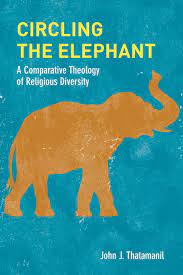
After that important 19-page introduction, the first numbered chapter is “Religious Difference and Christian Theology: Thinking About, Thinking With, and Thinking Through.” A careful reading and understanding of the author’s points there helps the reader to understand the scholarly discussion of exclusivism, inclusivism, and pluralism in the next two chapters. Chapters 4 and 5 deal with the complexity and misunderstanding of the concepts of religion and the religious, which according to the author have often been problematic.

After dealing in chapter 6, “The Hospitality of Receiving,” with the thought and practice of Gandhi and Martin Luther King, Jr., the following chapter is the author’s contribution to constructive theology as he writes about “God as Ground, Singularity, and Relation: Trinity and Religious Diversity.” The book concludes, then, with the ten-page chapter titled “This Is Not a Conclusion.”

Author Thatamanil

John J. Thatamanil was born in Gerala, India, and migrated to Brooklyn with his parents when he was eight years old. In India and then in the U.S. he was affiliated with the Mar Thoma Church, which, it is claimed, can be traced back to Thomas, one of Jesus’ twelve apostles, who went to India to evangelize. In addition to his personal knowledge of Hinduism, the indigenous religion of India, the author also has deep, first-hand knowledge of Buddhism, and in the Preface he informs his readers that he continues both “Buddhist practice and Christian worship” (p. xvii).

He earned the Ph.D. degree at Boston University in 2000 and is noted for his scholarly study of Christian theologian Paul Tillich. The influence of Tillich is evident at various places in the book. After several years as a professor at Vanderbilt Divinity School, in 2011 Thatamanil became an Associate Professor of Theology and World Religions at Union Theological Seminary.

The Central Issue

Thatamanil’s first sentence in the Introduction identifies the central issue of the book: “Is religious diversity fundamentally a problem?”—and he particularly seeks to deal with the question of whether it is, or should be, a problem for Christians. He tips his hand, though, when in the epigraph at the beginning of the Introduction he cites Rabbi Abraham Joshua Heschel’s words spoken at Union Seminary in 1965: “In this aeon diversity of religions is the will of God.”

The author wants to see religious diversity as promise rather than as problem. “That,” he states, “is the question Circling the Elephant sets out to explore” (p. 1). A strong advocate of harmony and mutual acceptance, Thatamanil says, “To imagine religious diversity as promise instead of problem is to refuse those who seek to turn diversity into divisiveness” (p. 2). Positively, he emphasizes that the world needs “religious diversity in order to register and receive the rich multiplicity of the divine life” (p. 5).

It is in this setting that the old fable is considered, and the author states that if the tale is suitably reformulated, it is “appealing because it gives theologians a way to imagine real diversity as a positive good” (p. 6). So, after discussing five problems with the old allegory, Thatamanil states, “This book is a Christian exercise in pachyderm perambulation” (p. 11).

The foundational first chapter is “Religious Difference and Christian Theology: Thinking About, Thinking With, and Thinking Through,” and he begins with discussing “Should Religious Diversity Be a ‘Problem’ for Christians? (pp. 21~29). He concludes this important topic by saying that there are “robust reasons for believing that we need not only our neighbors but also their [religious] traditions if we are to move more fully into the life of God.” Thus, “Only a ‘relational pluralism’ in which the salvific power of our various traditions [is] mobilized and animated through relationship and mutual transformation can serve as an adequate foundation for a theology of religious diversity.”

So, focusing on this central issue, Thatamanil declares: “This book articulates the hope for a comparative theology of religious diversity” (p. 34). And at the end of chapter 1 he explains that he seeks “to formulate a theology of religious diversity that makes interreligious learning and mutual transformation possible (p. 40).

Exclusivism, Inclusivism, and Pluralism

For many years now, Christian theologians of religion have identified and written about three positions that are widely known as exclusivism, inclusivism, and pluralism. Thatamanil discusses these three positions in his second and third chapters, negatively evaluating all three except for what he proposes as “relational pluralism” in the third chapter. Before presenting his specific assessments/criticisms, though, he reiterates his central position near the beginning of the second chapter: “A theology of religious diversity that celebrates attentive learning might move away from regarding religious diversity as a problem to be solved and recognize religious diversity as a promise to be received” (p. 42). Thus, he is positive about relational pluralism as he notes that it is marked by a “taste for multiplicity” and shows its “delight in the gifts of other wisdoms” (p. 103).

The last part of the third chapter is “A Concluding Warning: The Trouble with Religion,” and this is his springboard into the next two chapters.

Analyzing “Religion” and “the Religious”

Near the end of chapter one, Thatamanil states: “We need theological projects that remind us that the invention of ‘religions’ and the invention of races were historically coterminous and part of a single, albeit multifaceted, imperial project” (p. 39). Thus, the third chapter is his criticism of the use of the word/concept “religion” and the next chapter explains how he prefers to use the adjective “religious” rather than the reified noun. He thinks that there is “little empirical resonance between the way Western scholars imagine religion and the way religious identities are actually lived out on the ground” (p. 127).

At the end of the fourth chapter, the author writes, “To be religious is not to belong to a timeless cultural-linguistic framework with a deep and stable transhistorical grammar but to seek comprehensive qualitative orientation by the creative use of contested and porous traditions that are always composed of what they are and what they are not” (p. 151). That is his lead into the fifth chapter: “Defining the Religious: Comprehensive Qualitative Orientation.” The subtitle expresses his attempt to explain what being religious is all about.

Thatamanil writes, all in italics,

Any qualitative interpretation of the felt character of the universe . . . I take to be religious when such an interpretation is accompanied by a commitment to practices that shape communal and personal comportment in the universe as so interpreted. Conversely, commitment to practices that so shape communal and personal comportment, such that they imply and generate a qualitative interpretation of the felt character of the universe . . . is also religious (p. 164).

It needs to be noted that the author recognizes that “secular institutions and activities continue to perform religious work.” He thinks that the religious “refuses to be confined to the sphere of religion or the religious even though moderns have come to think of comprehensive qualitative orientation as the special prerogative of what we now call religions” (p. 172). Thus, he has brief sections on “Economics as Religion” (pp. 183~7) and “Capitalism as Religion” (pp. 187~190).

Learning from Other Religions

Chapter 6 is “The Hospitality of Receiving: Mohandas Gandhi, Martin Luther King, Jr., and Interreligious Learning.” In some ways, since it deals with well-known people and events, this is one of the easiest chapters in the book to read and understand—but perhaps it is also the most problematical.

Thatamanil highly evaluates Gandhi’s learning and internalizing Tolstoy and his teaching about Jesus’ Sermon on the Mount, and then in turn praises MLK, Jr., for using what he learned from Gandhi. He concludes, “Even traditionalist Christians can confess that God has disclosed God’s self most fully in the Christ and yet also believe that one’s Hindu neighbor may see dimensions of that fullness that Christians have not yet appreciated” (p. 211). While that may well be so, that is quite different from what he wrote, with reference to MLK, Jr., on the previous page: “. . . no tradition affords more complete or efficacious access to ultimate reality than any other.”

A New Formulation of the Trinity

One of the author’s major purposes in this book is presenting a new formulation of what Christians have traditionally called the doctrine of the Trinity, and this is what he sets forth in the seventh chapter, “God as Ground, Singularity, and Relation: Trinity and Religious Diversity.”

It is difficult to summarize his argument succinctly, so suffice it to say that he expresses the traditional Christian concept of God as Father, Son, and Holy Spirit by forwarding the concept of “God as ground, singularity, and relation” (p. 217)—and he says that this formulation “is just one Christian theologian’s venture at redescribing the elephant after a series of forays into Buddhist and Hindu traditions” (p. 220). However, the idea of God as the ground of being is based on German philosopher Martin Heidegger and Christian theologian Paul Tillich as well as on the Hindu emphasis on the nonduality of Brahman and atman.

Thatamanil’s discussion of singularity is mostly based on the ideas of Christian mystics and the theologian John Duns Scotus (1266~1308). Also, in formulating the third part of the Trinity, the author uses the word Spirit some, but never refers to Holy Spirit. He does emphasize this as his central point: “Relation names the truth that nothing whatsoever is what it is apart from its relation. To be is to be in relation” (p. 240). (He might have introduced the Bantu/South African concept of ubuntu here, but he didn’t. Thich Nhat Hanh’s emphasis on “we inter-are” could also have been included here, but it is not mentioned until the last chapter, on p. 251—and Nhat is misspelled there and in the index.)

Near the end of this chapter, Thatamanil emphasizes his main point that we need to be engaged in “the work of learning about our neighbors, the work of learning from our neighbors so that we might ourselves learn more about God” (p. 247).

The Conclusion which is Not a Conclusion

The eighth and last chapter of Thatamanil’s book is titled “This is Not a Conclusion.” That is partly because “interreligious learning is an endless process because there is always more to be known” (p. 249). In summarizing the thrust of his book, though, the author writes, “Circling the Elephant repudiates religious isolationism and calls for thoroughgoing vulnerability” (p. 251), and he asserts that “we can no longer think of religious traditions as isolated blindfolded persons, each focused on one aspect of the elephant because each tradition, in its spiraling around ultimate reality, begins to interpenetrate each other” (p. 253). Further, “We must circle the elephant together if we are to understand each other, let alone the elephant.”

THE BLIND MEN AND THE ELEPHANT

A HINDOO FABLE

I.

IT was six men of Indostan
To learning much inclined,
Who went to see the Elephant
(Though all of them were blind),
That each by observation
Might satisfy his mind.

II.

The First approached the Elephant,
And happening to fall
Against his broad and sturdy side,
At once began to bawl:
“God bless me!—but the Elephant
Is very like a wall!”

III.

The Second, feeling of the tusk,
Cried: “Ho!—what have we here
So very round and smooth and sharp?
To me ‘t is mighty clear
This wonder of an Elephant
Is very like a spear!”

IV.

The Third approached the animal,
And happening to take
The squirming trunk within his hands,
Thus boldly up and spake:

“I see,” quoth he, “the Elephant
Is very like a snake!”

V.

The Fourth reached out his eager hand,
And felt about the knee.
“What most this wondrous beast is like
Is mighty plain,” quoth he;
“‘T is clear enough the Elephant
Is very like a tree!”

VI.

The Fifth, who chanced to touch the ear,
Said: “E’en the blindest man
Can tell what this resembles most;
Deny the fact who can,
This marvel of an Elephant
Is very like a fan!”

VII.

The Sixth no sooner had begun
About the beast to grope,
Than, seizing on the swinging tail
That fell within his scope,
“I see,” quoth he, “the Elephant
Is very like a rope!”

VIII.

And so these men of Indostan
Disputed loud and long,
Each in his own opinion
Exceeding stiff and strong,
Though each was partly in the right,
And all were in the wrong!

MORAL.

So, oft in theologic wars
The disputants, I ween,
Rail on in utter ignorance
Of what each other mean,
And prate about an Elephant
Not one of them has seen!

~John Godfrey Saxe (1816~87)

Posted in Book Reviews | Leave a comment

Writings about Apologetics

On April 15, I posted a new blog article (on my regular blogsite) titled “Apology for Apologetics.” That post, and the comments made about it, can be accessed by clicking here.

The blog post just mentioned was directly related to the post I made on this blogsite on April 12, and it should be easily found below.

Both of the above refer to the last essay I had published before retiring (in 2004) as a professor at Seinan Gakuin University in Fukuoka City, Japan. Here is the link to that essay, mainly about the German theologian/apologist Karl Heim.

I would be pleased to receive comments, or questions, about any of the above.

Posted in Uncategorized | Leave a comment