Cruz Control?

Most of us didn’t know much about U.S. Senator Ted Cruz (R-Tex.) until fairly recently. He became widely known, of course, after his 21-hour pseudo-filibuster on the Senate floor on Sept. 24. And since October 1 he, and those who agree with him, have been largely in control of the partially shutdown federal government.

Some basic facts about Cruz, who has been a member of the Senate only since January of this year: He was named Rafael Edward Cruz at the time of his birth in December 1970 in Calgary, Canada. Even though his father, Rafael Cruz, was born in Cuba, his mother, Eleanor Darragh, was born in Delaware. Because of his mother’s citizenship, Sen. Cruz is also an U.S. citizen.

After graduating as the 1988 valedictorian of Second Baptist High School in Houston, Cruz graduated from Princeton University and then was a magna cum laude graduate at Harvard Law School in 1995. He is clearly nobody’s dummy. But even brilliant people can be misguided in their political and religious views.

Recently I have received two emails mentioning Cruz’s father. A “Thinking Friend” in Louisiana wrote that Ted Cruz’s family became Baptists when they escaped from Cuba. Dan also said, “I saw a video of Cruz’s father, speaking in broken English, comparing Fidel Castro and Barack Obama.” (Here is a link to that video.)

Then a good friend at church sent the link to this article by Chris Hedges and asked for my comments. Hedges refers to Rafael Cruz as “a rabid right-wing Christian preacher.” That seems to be an accurate depiction of the man.

Image

Rafael was born in Cuba in 1939, and as a teenager became involved in the revolution against Batista. In 1957 he was jailed and tortured before fleeing to Texas with a student visa, where he graduated from the University of Texas in 1961.

 In a recent advertisement for an audio Spanish Bible narrated by Rafael Cruz, he is said to be “Director of Purifying Fire Ministries and a professor of Bible and Theology at Advance Bible Institute.” I could find no other information about either entity. And I have also been unable to find any church location for Cruz’s ministries in Carrollton, Texas, where he lives.

 Suzanne Hinn, wife of televangelist Benny Hinn, is the founder of an organization called Purifying Fire International, and Cruz has been identified with that group. But in spite of the similarity of the names, I could find no evidence that they are linked, in spite of some articles (probably incorrectly) connecting the two.

 An Oct. 1 article on Huffington Post links Cruz to an ultra-rightwing ideology known as Christian dominionism or Christian reconstructionism, a frightful theology I wrote about in my book “Fed Up with Fundamentalism” (pp. 48-51). That in itself is cause for considerable concern.

 Rafael Cruz, who became an American citizen in 2005, has been an outspoken cheerleader for his son Ted and his ideas, especially among conservative Christians. A recent story in the Washington Times is titled, “Rafael Cruz energizes Colorado Christians.” He was speaking at a Restoring Christian Values brunch before preaching at a Colorado Springs church on Sunday, Sept. 29.

 The brunch was partially sponsored by CitizenLink, an affiliate of Focus on the Family. In an Oct. 4 interview posted on their website, Cruz spoke mainly, and in strong terms, against Obamacare, which he opposes as much as his son does.

 The welfare of the nation will continue to suffer if we allow the country to fall under the control of ideas forwarded so forcefully by Sen. Cruz and his father.

Posted in Regular Post | Tagged | Leave a comment

Remembering Jonathan Edwards

Martin E. Marty, the eminent church historian, wrote earlier this week about the Sept. 26-28 conference feting Billy Graham. In his article, Marty averred that Graham is “on the Mt. Rushmore of Protestant American shapers such as Jonathan Edwards and Martin Luther King.”
Everyone knows who Graham and King are. But what about Edwards, who was born 310 years ago today, on October 5, 1703? (That was about four months after the birth of John Wesley, whose influence in England was perhaps even greater than Edwards’s in New England.)
The Connecticut-born Edwards is certainly worth remembering and honoring, even by those of us who don’t agree with some of his emphases.
About six weeks ago, I finished reading James Wm. McClendon’s book “Systematic Theology: Ethics” (1986). I was surprised when I found that “Sarah and Jonathan Edwards” is a chapter in that book. Jonathan and Sarah (Pierpont) married in 1727, when she was only 17. McClendon states that they “were lovers,” and that their love “drew them heavenward in a union at once spiritual and uncommon” (p. 131).
Edwards, a Puritan, became the pastor of a Congregationalist church, First Church of Northampton, Mass. He succeeded his grandfather, Solomon Stoddard who had served as pastor there for 60 (!) years, from 1669 to 1729.
Edwards was also a leader of the “Great Awakening,” a revival movement that started in 1734 and lasted for around 25 years. His emphasis on personal religious experience called infant baptism into question.
Thus, according to church historian Justo González, “many Congregationalists and Presbyterians, led by the Awakening’s emphasis on personal experience, eventually rejected infant baptism and became Baptists. Entire congregations did so” (“The Story of Christianity,” II:289).
Edwards is best remembered for delivering the most widely known sermon in the United States: “Sinners in the Hands of an Angry God,” preached in July 1741. That sermon has often been included in anthologies of American literature.
“The God that holds you over the pit of hell, much as one holds a spider, or some loathsome insect over the fire, abhors you, and is dreadfully provoked: his wrath towards you burns like fire; he looks upon you as worthy of nothing else, but to be cast into the fire.” This is a quote from Edwards’s famous sermon, but I’m afraid it would not have the same effect now as it did 270 years ago.
Image
Edwards’s most widely read book is the biography of a young missionary to the Native Americans who died at the age of 29 in 1747. It is titled “The Life of David Brainerd” (1749), and has never gone out of print, having positively influenced a great many missionaries through the years.
In the winter of 1758, Edwards traveled down to New Jersey to become the president of the college which later became Princeton University. When a smallpox epidemic struck the region, in order to serve as a model and example to his students Edwards received a smallpox vaccination—but he tragically contracted the disease and died that March.
During his short time in New Jersey, Edwards had stayed with his daughter, Esther. She was the widow of the first president of the college, Aaron Burr, who had died in Sept. 1757. So Jonathan was the grandfather of Aaron Burr, Jr., the third Vice-President of the U.S.
Marty asked his readers to decide who they would select for the fourth face on the “Mt. Rushmore of Protestant American shapers.” Who would be your pick?
Posted in Regular Post | Tagged | Leave a comment

“Don’t Worry, Be Happy”

Although I remember well his best known song, I hadn’t remembered that Bobby McFerrin was the one who sang “Don’t Worry, Be Happy.” That song topped the Billboard Hot 100 charts on Sept. 24 and Oct. 1 in 1988, twenty-five years ago now. It was the first a cappella song to ever reach number one. Then in February 1989 it also garnered the Grammy Award for Song of the Year.

Image

The lyrics for McFerrin’s lilting song seem to have been inspired by Meher Baba, whose picture with the words “Don’t Worry, Be Happy” appeared on numerous posters and inspirational cards. Baba, whose birth name was Merwan S. Irani, was a “spiritual master” from India, who claimed to be an Avatar, God in human form.

So with his hit song McFerrin (b. 1950) made Baba’s simple words known around the world. People greatly enjoyed both the music and the appeal of the lyrics. George H. W. Bush even used McFerrin’s popular song in his 1988 U.S. presidential campaign—until he had to stop doing so because of McFerrin’s objection.

One of my good friends always includes the words “Be well and feel good” before his name at the end of his email messages. That is a nice wish, but we don’t always have control over whether or not we are well, nor completely over how we feel. But I assume my friend David also likes the words “Don’t worry, be happy.” And we can have considerable control over worry and some over whether or not we are happy.

Long ago I heard it said that we humans worry about two things: things we can change and things we can’t change. If we can change something we don’t like, we should get busy and do it rather than just worrying about it. And if we can’t do anything about it, there is no use to worry.

And then I remember these words attributed to Abraham Lincoln: “Most people are about as happy as they make up their minds to be.” Just last week I saw an article on “The Habits of Supremely Happy People.” The author of that piece cited psychologist Martin Seligman, who stresses that at least 40% of our happiness is up to us.

So perhaps to a large degree we can be happy and not worry, if we so choose.

I became interested in learning more about McFerrin when his paraphrase of Psalm 23 was sung by the choir in the church June and I attend. The lyrics of that song begin,

                 The Lord is my Shepherd,

                 I have all I need,      

                 She makes me lie down in green meadows,

                 Beside the still waters, She will lead.

                 She restores my soul, She rights my wrongs,

                 She leads me in a path of good things,

                 And fills my heart with songs.

McFerrin wrote those lyrics as a tribute to his mother, but it is a good reminder that God can (and probably should) be pictured as Mother as well as Father. There are several YouTube videos of McFerrin’s “Psalm 23,” and I particularly enjoyed this one (click here), which includes a tribute to famous women throughout history.

Earlier this year McFerrin released a new album, “spirityouall,” and he talks about it in an interesting interview on the May 24 Religion & Ethics Newsweekly program (found here).

Perhaps McFerrin can sing about being happy and not worrying because of his deep faith, such as he expressed in “Psalm 23” and in his new album.

Posted in Uncategorized | Leave a comment

The Levellers

This article is being posted on the 370th anniversary of a battle you may never have heard of as an excuse to write about a group you may never have heard of. But there is some value in knowing about First Battle of Newbury (fought on Sept. 20, 1643) and especially about the group known as the Levellers.

(The group I am writing about, though, is not to be confused with the English rock band founded in 1988 and named the Levellers.)

While most USAmericans know quite a bit about the Civil War in the U.S., most of us don’t know much about the English Civil War, which was fought in the 1640s. One of the major battles of that war was fought at Newbury, about 60 miles west of London.

That First Battle of Newbury was led by King Charles I, who ended up losing his head (literally, in Jan. 1649) in the civil war. He was the leader of the Royalist forces, but the Parliamentarian forces won the battle.

Thomas Prince was on the side of the Parliamentarians in the English Civil War, and he was badly wounded at the Battle of Newbury. In the late 1640s, Prince, along with John Lilburne and Richard Overton, became a leader of a political movement that came to be known the Levellers.

If you have read “A Thicker Jesus: Incarnational Discipleship in a Secular Age,” Glen Harold Stassen’s 2012 book, you know something about these matters, for he narrates how Overton and the other Levellers were “pioneers of democracy.”

Stassen also explains that the Levellers group was one of the “free-church sects,” along with the Anabaptists, Baptists and Quakers, which had considerable influence on the development of democracy in England and then in New England and the other Colonies.

While there is some confusion about the origin of their name, it is clear that the Levellers believed all people should be equal before the law; that is, the law should equally protect the poor and the wealthy. They were also advocates of the complete freedom of religion.

Overton (1599-1664) was a Baptist during the “contentious days” of the English Civil War. According to Stassen, “He strongly advocated the human right of religious liberty on the biblical basis of following Jesus” (67-68). In 1647 Overton published the first comprehensive doctrine of human rights.

Overton first made a confession of faith and was baptized at the Waterlander Mennonite Church in Holland in 1615. (The Waterlanders had broken off from the main Mennonite branch in 1555, and by 1615 they were comprised of about 1,000 baptized believers in Amsterdam.)

But back in England he became a Baptist, and also became friends with Roger Williams, it seems. Williams left England for Boston in 1630 and founded the first Baptist church in North America later that decade. In the 1640s he was writing the same sort of thing about religious liberty in New England that Overton and the other Levelers were writing in England during that same decade.

Stassen links the central emphases of Overton to the American Pledge of Allegiance, saying that the words about “liberty and justice for all” were central in Overton’s writings. (It is estimated that Overton wrote about fifty pamphlets arguing for political and religious liberty.)

Thinking about the Levellers and their emphasis on equality and justice reminded me of this cartoon, which you may have seen on Facebook where I found it.

Image

Or maybe there is not much difference between equality and justice, if you are talking about eye level rather than where one’s feet are.

Posted in Uncategorized | Tagged , , | Leave a comment

In Memory of Addie, Cynthia, Carole and Denise

You may not have recognized their names, but you doubtlessly remember something about the four girls who were tragically killed 50 years ago today in an act of racial violence.

It was 10:22 on Sunday morning, September 15, 1963, when a bomb exploded at the 16th Street Baptist Church in Birmingham, Ala., taking the lives of Addie Mae Collins, Cynthia Wesley, Carole Robertson and Denise McNair, and injuring 22 others.

As I wrote on his birthday anniversary eight months ago today, not long after Martin Luther King’s powerful “I Have a Dream” oration (on August 28), there was an escalation of violent racism in the nation, and King himself talked about his dream turning into a nightmare.

On that fateful 9/15 Sunday morning, four “beautiful, unoffending, innocent Negro girls were murdered” (King’s words) in an act of racially motivated terrorism as they were going to their church basement assembly room to hear a sermon entitled “The Love that Forgives.”

At the funeral service for three of the young women on Sept. 18, King referred to them as “the martyred heroines of a holy crusade for freedom and human dignity.” And so they were.

As you see in the picture, at the top of Addie Collins’s gravestone are the words, “Civil Rights Martyr,” and the inscription at the bottom says, “She died so freedom might live.”

Image

And the tragic deaths of Addie and her friends did help spur Congress to pass the Civil Rights act less than nine months later and then the Voting Rights Act in 1965. (The latter was inexplicably gutted by the Supreme Court earlier this year.)

The martyrdom of Addie, Carole, Denise and Cynthia (and others) also paved the way for great achievements of other Black girls. In her mother’s womb at the time of the tragedy, a little African-American baby was born just over four months later and named Michelle Robinson. She is now the First Lady of the United States of America.

Extensive commemorative activities have been taking place in Birmingham over the past few days, and this morning the 16th Street Baptist Church is observing the “50th Year Commemoration of the Church Bombing” with Sunday School at 9:30 and the worship service at 10:45.

The Sunday School lesson is “A Love that Forgives,” and the guest preacher at the worship service is Dr. Julius Scruggs, president of the National Baptist Convention.

This past Tuesday, the Congressional Gold Medals were bestowed posthumously upon those four girls. If they had not been killed, one would now be 61 and the other three 64 years old.

The Congressional Gold Medal has been used to honor world leaders, military heroes, scientists, actors, artists, and others. It was first awarded to George Washington in 1776, and was most recently awarded in 2011 to those who died in the 2001 terrorist attacks.

The “4 little girls” martyred on 9/15/63 are worthy recipients of Congressional Goal Medal, which with the Presidential Medal of Freedom are the highest civilian awards in the United States.

Note: On Friday, Religion and Ethics Newsweekly had a very find segment about the 50th anniversary of the 9/15/63 bombing [click here]. Some images from that 1963 explosion are found on here on YouTube. A song called “4 Little Girls” and some other pictures can be accessed here . And “4 Little Girls” is also the title of a 1997 documentary film directed by Spike Lee; I finished watching it yesterday, and it is well worth seeing.

Posted in Regular Post | Tagged | Leave a comment

When Will It End?

Tomorrow is September 11, and for twelve years now just hearing “9/11” has evoked horrifying memories of the terrorist attacks on the U.S. Those dastardly attacks triggered the War on Terror by the U.S., a “war” that continues to this day.

President Bush first used the words “war on terror” on Sept. 20, 2001, and that war officially began 17 days later, on Oct. 7, with the invasion of Afghanistan. Now called “Operation Enduring Freedom,” the war in Afghanistan continues and is now the longest war in U.S. history.

In his State of the Union address in February of this year, President Obama declared that “by the end of next year, our war in Afghanistan will be over.” While that plan seems to have strong support in the citizenry and pulling U.S. troops out of Afghanistan will likely take place as scheduled, that won’t mean an end to the War on Terror.

The burning question is: when will it end?

After seeing the movie “Dirty Wars” this summer, I had the sick feeling that there would most likely not be an end to the War on Terror during my lifetime (which I am expecting to be at least another 15 years).

Back in May, the President declared that the War on Terror “must end.” But several Republican Senators, as well as a majority of U.S. citizens, disagreed with him.

Sen. John McCain, for example, blasted the President’s declaration that the war on terror must end as premature and foolhardy, saying that a desire to bring the war “to a compete closure contradicts the reality of the facts on the ground” and declaring that “al Qaeda will be with us for a long time.”

June has often said to me that the military actions of the U.S. in Afghanistan in 2001, in Iraq in 2003, and then in many small-scale actions, such as drone attacks in Pakistan and Yemen, have been like hitting hornets’ nests. Retaliatory strikes have stirred up more and more hatred toward the U.S. (This is depicted well in this recent cartoon in The Economist.) Hornets' NextAnd now there is Syria. Even though point it does not seem to be a part of the war on terror as such, President Obama and Secretary of State Kerry are urging military action against Syria mainly because of its alleged use of chemical weapons.

A recent Pew Research Center poll, though, indicated that only 29% of the American adults surveyed favor a U.S. airstrike on Syria and 48% oppose such a strike. (The others were undecided.)

Nearly three-quarters (74%) of those polled think that U.S. airstrikes would likely create a backlash (stir up more hornets) against the United States and its allies in the region.

Nevertheless, last week the Senate Foreign Relations Committee, by a 10-7 vote, passed a resolution approving a military strike against Syria. It also set a 60-day deadline for the use of force in Syria, with an option for an additional 30 days.

This week the President is making strong appeals to Congress and to the American people, encouraging support for military force against the Assad regime in Syria.

But even if approved by Congress (which may not happen), or even if a strike is launched without congressional approval (which might happen), would such military action end within 90 days? Perhaps, but quite possibly not.

Let us pray that some good alternative to a missile strike, which now seems somewhat possible, will be implemented.

Posted in Regular Post | Tagged , , | Leave a comment

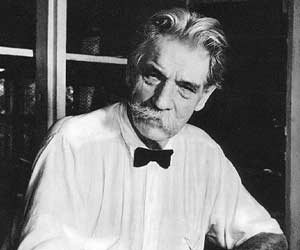
Remembering Albert Schweitzer

One of the outstanding persons of the twentieth century died 48 years ago yesterday. That was Albert Schweitzer, who passed away at the age of 90.

Schweitzer was born in 1875 in a town that had been part of France until the region was annexed by Germany four years earlier. By 1900 he had become a noted organist, had completed his doctor of philosophy degree, and was a Lutheran minister and seminary professor.

In 1904, though, Schweitzer felt God’s call to become a missionary to Africa. But he decided that in order to serve best in the jungles of Africa he should become a doctor, so he entered medical school. Upon completion of his medical training, but before leaving Europe, he then had to raise money to equip a clinic.

Finally, on Good Friday in 1913, Dr. Albert and his wife Helene, a nurse, set sail for Africa. They immediately began their medical work in Lambaréné, a small outpost in what was then known as French Equatorial Africa and now as the country Gabon. They soon were overwhelmed with patients.

It was not long, though, before World War I began. Since the Schweitzers were German citizens, they were seen as enemies of the French, who ruled the country to which they had gone. So they were placed under house arrest, and then in 1917 were moved to an internment camp in France.

By the time the war ended in 1918, their mission in Lambaréné had been destroyed and they were heavily in debt for medicines and supplies ordered for an African hospital that no longer existed.

During his first years in Africa, Schweitzer began to emphasize “reverence for life,” which became one of his “trademarks.” That emphasis is similar to a central idea in Buddhism, and there is even a Buddhist temple in Kumamoto Prefecture, Japan, that bears Schweitzer’s name. June and I enjoyed visiting there several years ago.

In 1924 Schweitzer journeyed back to Africa and started from scratch once again. This time his work flourished—and gradually became known around the world. Dr. Albert became so well known and his emphasis on reverence for life so admired that in 1952 he was awarded the Nobel Peace Prize.

albert-schweitzer

Worldwide attention and acclaim led some to look for flaws in Schweitzer, and, indeed, there did seem to be some. In the 1950s he was accused, perhaps rightfully, of being paternalistic, colonialistic and even racist in his attitude towards Africans.

Still, those who leveled such criticisms had not labored or suffered anything close to the extent that Schweitzer had. And they certainly had not done nearly as much to help so many people in physical need.

Once when asked how he had accomplished so much, the old doctor responded by repeating what he had earlier told some of his students: “I don’t know what your destiny will be, but one thing I know: the only ones among you who will be really happy are those who will have sought and found how to serve.”

Those are certainly words well worth considering as we remember with appreciation the long and productive life of Dr. Albert Schweitzer, who died on September 4, 1965.

Note – Recently read/viewed and recommended: “Albert Schweitzer: Serving a Higher Calling,” chapter 15 in Ace Collins, Stories behind Men of Faith (2009) and “Albert Schweitzer: Called to Africa” (2006 film).

Also: This blog posting and more than 300 others can be found at http://www.theviewfromthisseat.blogspot.com/

Posted in Regular Post | Tagged , | Leave a comment

Branch, Jackie, and Pee Wee

Earlier this month June and I watched “42,” the new movie about Jackie Robinson, who in 1947 became the first African-American to play in major league baseball.

Strangely, I don’t remember much about him specifically. His being a black player seemed to be no big deal four years later when I saw Robinson play. My Aunt Mary took me and a friend to St. Louis in June of 1951, and the first day there we saw the Cardinals play the Brooklyn Dodgers. Robinson (as well as Pee Wee Reese) was in the starting lineup.

The movie “42” also features Branch Rickey, who became general manager of the Brooklyn Dodgers in 1942. He determined in 1945 to bring an outstanding “Negro” player to the major leagues.

In “42” Harrison Ford did a wonderful job portraying Mr. Rickey (1881-1965), as most people called him. Since Rickey’s parents were staunch Methodists, they named him Wesley, but he generally went by Branch, his middle name, taken from John 15:2.

According to the movie, Branch liked Robinson as a strong candidate for the first black major league player (and there were many others) partly because of Jackie’s religion. “He’s a Methodist,” says Rickey. “I’m a Methodist. God’s a Methodist!”

Image

In his first season with the Dodgers, Robinson played first base, and one of his teammates and main supporters was “Pee Wee” Reese, the shortstop and captain of the team. Little did I know when I saw them play in 1951 that eight years later I would become pastor of the Baptist church in Ekron, Kentucky, the town nearest to where Pee Wee was born.

This month I discovered that Pee Wee’s grandmother died in 1924 and was buried in the cemetery right behind the church where I conducted several committal services during my four-plus years as pastor in Ekron.

Pee Wee was born in 1918 and lived near Ekron until he was eight years old when his family moved to Louisville. However, his father Carl Reese died in 1938 and was buried in the Buck Grove Baptist Church Cemetery, about three miles from Ekron.

When we lived in Ekron, I remember hearing some of the old-timers around Buck Grove talk not just about Pee Wee but about his father. Some said Carl was probably a better baseball player than his son but just never had the chance to play professionally.

One of the touching scenes in the movie portrays the real-life incident that occurred when the Dodgers played in Cincinnati for the first time in the fall of 1947. Jackie was the target of considerable hostility, and Kentuckian Pee Wee even received hate mail before that first game with the Reds in Crosley Field.

With the crowd booing as the Dodgers took the field, Pee Wee ran over to first base and put his arm around Jackie in an act of friendship and solidarity.

Image

That touching event is depicted in a statue unveiled at MCU Park in Coney Island in 2005. Sadly, that statue was defaced with swastikas and racial epithets earlier this month.

Still, societal conditions are certainly much better now than they were in 1947—or in 1963. But as the President and others reminded us Wednesday at the Lincoln Memorial, there is still much to be done for racial equality and justice in this country.

Note: This blog posting – and more than 300 others – can also be found at http://theviewfromthisseat.blogspot.com

Posted in Regular Post | Tagged , , , | Leave a comment

The Futility of Retaliation

Quite a celebration has been planned for next weekend in my hometown, Grant City, Missouri, in commemoration of its founding 150 years ago, in February 1863.

The town was named after Ulysses S. Grant, a Union solider in the Civil War who was stationed in Missouri when President Lincoln appointed him to be a brigadier general in August 1861. Grant then fought a series of successful battles and was promoted to major general in 1862.

But while people in Grant City will be celebrating its sesquicentennial, people in other parts of Missouri are remembering the terrible devastation of their houses and other property 150 years ago this month—just as the people of Lawrence, Kansas, recently remembered the destruction of their town on August 21, 1863, as I wrote about in my previous posting.

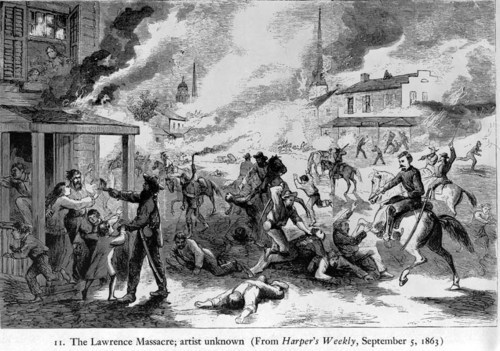
As a direct result of the Lawrence Massacre, and in an effort to defuse the “border war,” General Thomas Ewing issued Order No. 11 on August 25. That order resulted in the burning of most of the rural houses and crops of the Missourians who lived in Cass and Benton counties and parts of Jackson and Vernon counties. That was the area adjacent to the Missouri-Kansas border from the southwestern part of Kansas City to north of Nevada.

At that time, George Caleb Bingham was the Missouri state treasurer, and he knew and personally disliked Gen. Ewing. Bingham said to Ewing: “If you execute this order, I shall make you infamous with pen and brush.”

Even though Bingham also served as a Union soldier, he was appalled by the consequences of Order No. 11, which Ewing did execute. That resulted in much of those four counties being destroyed by fire, and the area came to be known as the “Burnt District.” The population of Cass County, for example, was reduced from 10,000 to 600. And in 1868 Bingham did paint a picture depicting the sad consequences of Order No. 11, which became the title of the painting.

On August 17, June and I went down to the River Market area of Kansas City and saw the reenactment of the issuance of Order No. 11. That took place across the street from Pacific House, the very building that was the headquarters of Ewing after he was promoted to brigadier general in March 1863 and given command of the District of the Border, which was comprised of Kansas and western Missouri. A small print of Bingham’s famous painting hangs on the wall in Pacific House now.

ImageOrder No. 11 was issued mainly in retaliation for Quantrill’s raid on Lawrence, which was largely in retaliation for James Lane’s raid on Osceola, Mo., in 1861. And so it went, violence begetting violence. This evokes the memory of Martin Luther King’s oft-quoted statement, “The old law of an eye for an eye leaves everybody blind.”

People of power never seem to learn, though. The terrorist attack of 9/11/01 spawned retaliation on Afghanistan, and the ongoing war on terrorism now conducted increasingly with drones and causing the death of non-terrorists, women and children as “collateral damage” continues to spawn anger toward the U.S.

Thankfully, the March on Washington led by King 50 years ago next Wednesday (Aug. 28, 1963) recognized that reconciliation is better than retaliation. I wish the “bushwhackers” and “jayhawkers” had recognized that in the 1850’s and ’60s.

And I wish the President and the U.S. government had recognized that in 2001, and would even now recognize the futility of retaliation and the urgent need to work more diligently for reconciliation.

Note: This blog posting – and more than 300 others – can also be found at http://theviewfromthisseat.blogspot.com

Posted in Uncategorized | Tagged , , , , , | 1 Comment

Border Wars

In celebration of my birthday last week, June and I made an overnight trip to Lawrence, Kansas. It was largely because of recently watching the 1999 Ang Lee movie “Ride with the Devil” that we decided to make the short trip to Lawrence and to do some sight-seeing there.

Part of the movie was about the infamous “Lawrence Massacre,” which occurred 150 years ago tomorrow, on August 21, 1863. That event, also known as “Quantrill’s Raid,” was a guerrilla attack led by William Quantrill. Between 150 and 200 men and boys were killed in that atrocious raid. Image

We re-traced the path of the guerrillas’ rampage, which began around 5 a.m. on that fateful August morning. We also visited the Watkins Community Museum of History, just a block from South Park that was part of the original layout of Lawrence when it was platted in 1854.

Watkins Museum houses exhibits from Lawrence and Douglas County—and a new permanent exhibition featuring the events of 1863 officially opened last Saturday. Fortunately, we were able to get a “peek preview” of that fine new $300,000 exhibition.

At noon on the fifteenth we dined in the historic Eldridge hotel. On that site, the Free State Hotel, a well-fortified structure built by the stanch anti-slavery Massachusetts Emigrant Aid Society to receive anti-slavery settlers as they arrived from the east, was completed in May 1856 – and burned down the same day by the avid pro-slavery sheriff and “ruffians” from Missouri!

Colonel Shalor Eldridge rebuilt the hotel, naming it Eldridge House. That building, completed in December 1858, was the destroyed less than five years later during Quantrill’s Raid. But Eldridge and others built it back in 1866.

The new Eldridge House was torn down in 1925 and then rebuilt as The Eldridge. In 1970, though, it was turned into an apartment house. But in 1985 it became a hotel again after the top four floors were completely rebuilt and the lobby restored to its original elegance.

Before the Civil War started, the guerrilla free-state fighters were known as “Jayhawkers,” and they often clashed with pro-slavery groups from Missouri known at the time as “Border Ruffians” or “Bushwhackers.” After the Civil War, the word “Jayhawker” became synonymous with the people of Kansas.

In 1890 when the University of Kansas, located in Lawrence, fielded their first football team they were called the Jayhawkers. Now the KU sports teams are known as simply the Jayhawks.

After June and I moved to Liberty in 2005, we became fans of the University of Missouri Tigers basketball team, and we especially enjoyed the exciting games with the KU Jayhawks. Those games were sometimes called “border wars,” though.

The more we learned about the real border wars of the 1850s and ’60s, the more uncomfortable we felt. We were not particularly happy when MU transferred to the SEC, bringing the MU v. KU rivalry to an end. But at least we are no longer regularly reminded of those horrendous days when the deadly border wars were fought.

Somehow we went through the Missouri school system not learning much about the appalling conflict between the Bushwhackers and the Jayhawkers. I don’t know if that wasn’t mentioned much back then or whether we just weren’t paying attention.

At any rate, although there has in the past been intense rivalry between the MU and KU sports teams, and while there is now some economic rivalry between the states especially in the Kansas City area, at least there is no longer actual fighting with lethal weapons.

Some things, thankfully, have improved over the last 150 years!

Note: This blog posting – and more than 300 others – can also be found at http://theviewfromthisseat.blogspot.com

Posted in Uncategorized | Tagged , , , , | 1 Comment